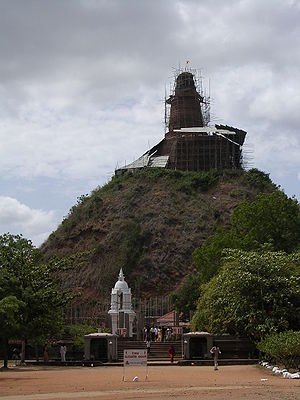
The Abhayagiri Dagaba is situated in Anuradhapura, Sri Lanka. It is one of the most extensive ruins in the world and one of the most sacred Buddhist pilgrimage cities. Historically it was a great monastic centre as well as a royal capital, with magnificent monasteries rising to many stories, roofed with gilt bronze or tiles of burnt clay glazed in brilliant colors. To the north of the city, encircled by great walls and containing elaborate bathing ponds, carved balustrades and moonstones, stood "Abhayagiri", one of seventeen such religious units in Anuradhapura and the largest of its five major viharas. Surrounding the humped dagaba, Abhayagiri Vihara was a seat of the Northern Monastery, or Uttara Vihara.
The term "Abhayagiri Vihara" means not only a complex of monastic buildings, but also a fraternity of Buddhist monks, or Sangha, which maintains its own historical records, traditions and way of life. Founded in the second century B.C., it had grown into an international institution by the first century of this era, attracting scholars from all over the world and encompassing all shades of Buddhist philosophy. Its influence can be traced to other parts of the world, through branches established elsewhere. Thus, the Abhayagiri Vihara developed as a great institution vis‑a‑vis the Mahavihara and the jetavana Buddhist monastic sects in the ancient Sri Lankan capital of Anuradhapura.
Lovamahapaya is a building situated between Ruvanveliseya and Sri Mahabodiya in the ancient city of Anuradhapura, Sri Lanka. It is also known as the BrazenPalace or Lohaprasadaya because the roof was covered with bronze tiles.
In ancient times, the building included the refectory and the uposathagara (Uposatha house). There was also a simamalake where the Sangha assembled on Poya days to recite the formula of the confessional. The famous Lohaprasada built by King Dutugemunu, described as an edifice of nine stories, was a building of this class. One side of the building was 400 ft (120 m) in length. There are 40 rows, each row consisting of 40 stone pillars, for a total of 1600 pillars. It is believed that it took six years for the construction of the building and the plan was brought from the heavens. The building was completely destroyed during the reign of King Saddhatissa. The small building in the center is late construction and is the Venue of Uposatha (chapter house) of the Maha Vihara even now.
The Bodhi Tree, also known as Bo (from the Sinhalese Bo), was a large and very old Sacred Fig tree (Ficus religiosa) located in Bodh Gaya (about 100 km (62 mi) from Patna in the Indian state of Bihar), under which Siddhartha Gautama, the spiritual teacher and founder of Buddhism later known as Gautama Buddha, achieved enlightenment, or Bodhi. In religious iconography, the Bodhi tree is recognizable by its heart-shaped leaves, which are usually prominently displayed. It takes 100 - 3,000 years for a bodhi tree to fully grow.
The term "Bodhi tree" is also widely applied to currently existing trees, particularly the Sacred Fig growing at the MahabodhiTemple, which is allegedly a direct descendant of the original specimen. This tree is a frequent destination for pilgrims, being the most important of the four main Buddhist pilgrimage sites. Other holy Bodhi trees which have a great significance in the history of Buddhism are the Anandabodhi tree in Sravasti and the Bodhi tree in Anuradhapura, Sri Lanka. Both are believed to have been propagated from the original Bodhi tree.
Samadhi statue is a statue situated at MahamevunaPark in Anuradhapura, Sri Lanka. It is said that this is one of the best pieces of sculpture. The statue is 8 feet in height and made of granite and the Dhyana mudra is symbolished - The posture of meditation in which Buddha sits in the cross - legged position with upturned palms, placed one over the other on the lap.
Dakkhina Stupa is a 2nd century BC stupa built over the cremated ashes of King Dutugemunu. It was constructed by Uttiya, a Minister of King Valagamba, in the Ancient Sacred city of Anuradhapura, Sri Lanka. For sometime by an error it was considered as Elara's tomb. King Kanittha Tissa had build an alms hall, King Gottabhaya built an uposathagaraya, where the bhikkhis assembled for the ceremony of confession, while King Agbo I constructed a large building. The Bhikkhus of the Sagalika sect resided here. Human bones collected collected at the site were sent to France for scientific analysis, which revealed that these ashes did belong to King Dutugemunu.
A beautifully paved footpath, several elevated platforms, ruins of an old hospital and remains of a terraced pond are what is unearthed at this 180 BC Buddhist monastery at the foothill of 600m high Ritigala Rock. Dating back to around 350 B.C is one of the oldest historical places mentioned in the ancient chronicles. (about 50km south east of Anuradhapura)
The monastery complex is built where it is believed to be the cremation grounds of the Mahinda Thera who introduced Buddhism to Sri Lanka. Founded by King Mahasena (276-303AD) the stupa at 120m high was the third tallest monument in the world at the time of the fall of Roman Empire.